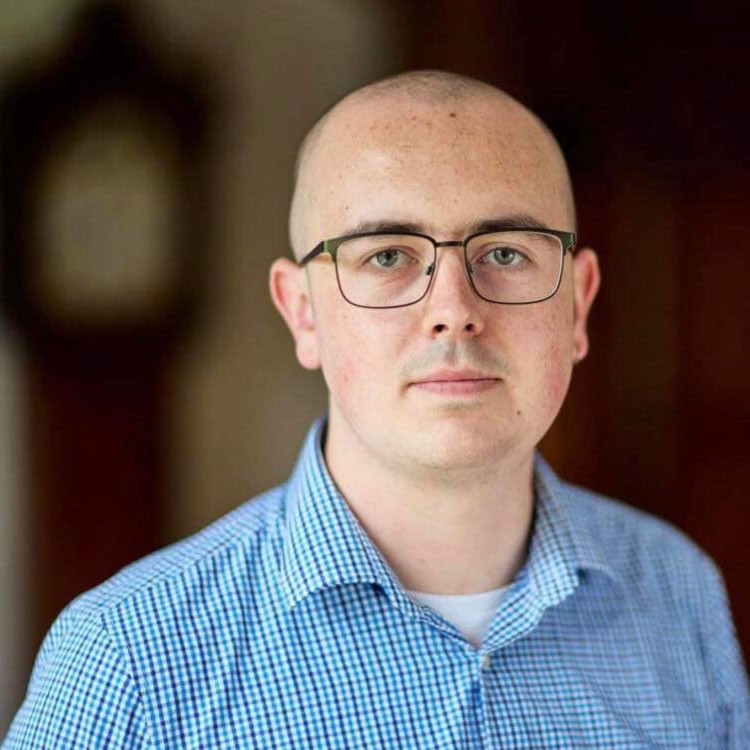
I'm a Postdoctoral Research Associate in Mathematical Epidemiology under the supervision of Prof. Robin Thompson at the Mathematical Institute, University of Oxford.
I am also a Stipendiary Lecturer in Applied Mathematics at Lady Margaret Hall, University of Oxford.
My current research interrogates where non-spatial epidemic models are sufficient to predict a major disease outbreak, and where spatial effects are dominant.
In early 2027, I will take up a London Mathematical Society Early Career Fellowship to work in Prof. Nik Cunniffe's group at the University of Cambridge, before joining Prof. Alexey Mikaberidze's group at the University of Göttingen later in 2027.
I enjoy working on many problems in mathematical biology, using a broad range of techniques from across applied mathematics, including agent-based models, partial differential equations, applied graph theory, optimal control, and solid mechanics.
I'm always keen to talk about maths and looking for new collaborations — please reach out!
A (work in progress) visualisation of my academic family tree can be found here.
My Erdős number is 4.
Teaching multiple undergraduate courses and conducting admissions interviews for prospective students.
Supervised two undergraduate students through the UNIQ+ programme. The seven-week summer placement offers talented students from under-represented and disadvantaged backgrounds a day-to-day experience of postgraduate research at the University of Oxford.
Supervised a group of four postgraduate students on a ten-week research project for the MSc in Mathematical Modelling and Scientific Computing at the Mathematical Institute, University of Oxford.
Designed and parameterised a Bayesian survival-analysis model in PyMC, transforming complex, large-scale datasets into probabilistic forecasts of asset failure. Working closely with an industrial partner, I refined and validated this tool to provide public-sector teams with actionable risk rankings, enabling them to prioritise maintenance before failures occur.
I also used R to develop and maintain an existing statistical forecasting model for the sales numbers of various products for a multinational corporation. Throughout the project, I upheld professional software-engineering standards—employing modular code design, version control in Git, and rigorous unit testing to deliver reliable, production-ready software.
Delivered an invited talk entitled “Mathematical models of single and collective cell migration in the cranial neural crest”.
Delivered a contributed talk entitled “The spontaneous emergence of leaders and followers in a mathematical model of cranial neural crest cell migration”.
Presented a poster entitled “An energy-based mathematical model of actin-driven protrusions in eukaryotic chemotaxis” at the Mathematical Institute, University of Oxford, receiving the poster prize.
Delivered a contributed talk entitled “An energy-based mathematical model of actin-based protrusions in eukaryotic chemotaxis”.
Delivered a contributed talk entitled “An energy-based mathematical model of actin-based protrusions in eukaryotic chemotaxis” at the joint BMC–BAMC meeting.
Delivered an invited talk alongside Prof. Philip Maini in the Swansea University mathematics department entitled “Follow the leader: collective cell migration in the cranial neural crest”.
Delivered a contributed talk entitled “Mathematical modeling predicts novel mechanisms of stream confinement from Trail/Colec12/Dan in the collective migration of cranial neural crest cells”.
Presented a poster entitled “Follow the leader: collective cell migration in the cranial neural crest”, receiving a prize of honourable mention.
Wrote “Collective cell migration in the chick cranial neural crest”, a case study for the Oxford Mathematics website on how mathematical modelling and experiments have been combined to understand how cranial neural crest cells migrate, and how leader and follower cells may emerge during migration.
Running mock tutorials for prospective undergraduates, familiarising them with the Oxford system and teaching style.
Leading classes for prospective undergraduates, working through selected problems with a focus on problem-solving techniques and logical reasoning.